Permanent Lighting
How Much Does Permanent Outdoor Lighting Cost in Birmingham? JellyFish and Bosso Pricing Explained
New Age Lights • August 2026 • Birmingham, AL • 9 min read
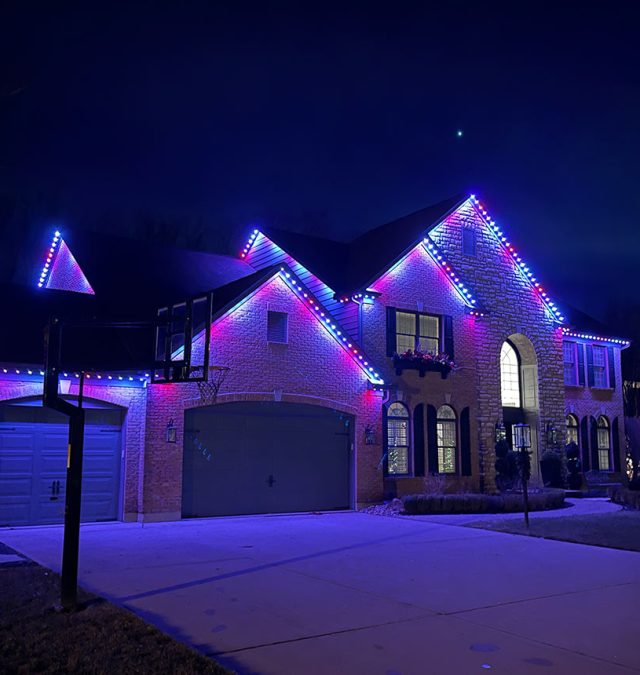
People call our downtown office every fall and ask for a price over the phone. We understand why, but a Homewood bungalow and a three-story house on the 280 corridor are not the same job, and a per-foot figure only becomes a real number once someone has counted the corners. Here is the honest frame: the manufacturer pricing for both systems we install, what pushes a Birmingham roofline up or down the range, and worked examples for the houses we see most.
What permanent lighting costs per linear foot
Both systems we install are priced by the job, and the job is mostly linear footage. The figures below are the manufacturers' own national guidance, not Birmingham quotes, but they are the right place to start.
| Item | JellyFish Lighting | Bosso Smart Lighting |
|---|---|---|
| Installed cost per linear foot | $25 to $35 (manufacturer guidance) | Not published; priced per project |
| Typical whole-home range | $3,000 to $6,000 | Manufacturer states an average customer spends about $5,000 |
| National average | About $4,600 | About $5,000 |
| Controllers | $650 to $850 each; one controller runs up to about 263 ft, systems expand to 2,400 ft | Up to 8 zones per controller, up to 4 controllers per account; UL-rated waterproof unit usually mounted in the garage |
| Warranty | 5 years parts; year one bumper-to-bumper (parts, labor, service) | 5 years parts; 1 year labor |
Those ranges are wide on purpose. A straight 100-foot fascia and a 100-foot run broken into nine segments across two dormers and a bay window use the same lights but not the same day. Full manufacturer detail is on the JellyFish Lighting site and the Bosso Smart Lighting site; our own pages on JellyFish in Birmingham and Bosso in Birmingham cover how we fit each one here.
What moves the per-foot price on a Birmingham roofline
Six things decide where in the range your house lands. Most of them you can eyeball from the curb before we arrive.
- Linear footage. Long, continuous runs are the cheapest foot you will buy. A Greystone or Ross Bridge front with 120 feet of unbroken fascia prices very differently per foot from 120 feet chopped into short returns.
- Peaks, dormers and gables. Every change of direction is a cut, a corner and time on the lift. The over-the-mountain stock in Mountain Brook, Homewood and the older Vestavia Hills crest streets was built between the 1920s and the 1950s with steep pitches, dormers and deep decorative eaves, and it carries more hand-fitting per foot than anything built in the last thirty years.
- Height and access. Two- and three-story elevations are normal in Hoover, Liberty Park and down the 280 corridor toward Chelsea, and a house that reads as two stories from the street is often three at the back. Lift work costs more than ladder work, and under the mature hardwoods of Mountain Brook and Homewood, finding a place the lift can stand is sometimes the hardest part of the day.
- Corners and returns. Wrapped porches, bay windows and side returns each add pieces. A simple rectangle has four corners; a 1940s Edgewood house with a porch, a bay and an offset garage can have fourteen.
- Track color. The channel is color-matched to your trim so it disappears in daylight. The dark bronze, copper and painted-wood trim common over the mountain still matches, but custom JellyFish track takes one to two weeks to arrive, so it affects scheduling more than price.
- Controllers and power. A JellyFish controller powers up to roughly 263 feet, so a front-only install almost always needs one; wrap the rear of a large lot and you may cross into a second. The controller needs a proper circuit and a serviceable home, usually the garage, and a long path from garage to roofline adds wiring time.
Front only or full perimeter
Most Birmingham installs are front elevation only, meaning whatever the street sees. That is where the curb appeal lives and where the money goes furthest, and a front-only run on a typical two-story is comfortably inside one controller and usually inside the manufacturer's typical range.
Full perimeter makes sense when the back of the house is where you live. Pool decks and covered patios in Hoover, Ross Bridge and the newer Trussville subdivisions get used from March to November, and warm white along a rear roofline does the job of a dozen string lights. The rear run costs more per foot than the front because it is higher: a walkout basement in Vestavia Hills or Chelsea puts the rear fascia a full story further off the ground than the front suggests, and that is lift work.
Worked examples by Birmingham housing type
These are illustrations, not quotes. Footage is representative of the house type, the math uses the manufacturer's $25 to $35 per-foot range for JellyFish, and every real house gets measured.
| House type | Scope | Illustrative footage | At $25 to $35 per ft | Notes |
|---|---|---|---|---|
| Homewood Edgewood or Hollywood bungalow, 1920s to 1940s | Front only | About 80 ft | $2,000 to $2,800 | Short run, but deep eaves and porch detail push toward the top of the range per foot |
| Vestavia Hills two-story colonial, older crest streets | Front plus returns | About 140 ft | $3,500 to $4,900 | Seen from below; the outline matters more than the detail |
| Hoover, Ross Bridge or Greystone two-story | Front with gables | About 180 ft | $4,500 to $6,300 | Straight fascia, seamless gutter; height is the cost, not the hardware |
| Mountain Brook 1930s Tudor | Front only | About 120 ft, heavily segmented | $3,000 to $4,200 | Expect the top of the range; dormers, slate and tree canopy all add time |
| Chelsea or 280-corridor home on a sloping lot | Front plus rear over walkout | About 300 ft | $7,500 to $10,500 | Passes one controller's 263 ft; add $650 to $850 for a second |
The Mountain Brook house and the Hoover house can land at similar totals for opposite reasons: one is short and fiddly, the other long and tall. If your house is in Hoover or Mountain Brook, those pages explain what we plan around on each.
What is the average cost of permanent outdoor lighting?
Nationally, JellyFish puts its average installed system around $4,600 and Bosso puts its average customer at about $5,000. Birmingham's housing splits hard along Red Mountain, so the local spread around those averages is wide: close-in Homewood fronts often land under the average, and Hoover, Liberty Park and Shelby County houses with a rear run often land over it.
How much does JellyFish Lighting cost per foot?
The manufacturer's published guidance is $25 to $35 per linear foot installed, with controllers at $650 to $850. That covers the color-matched aluminum track, the individually addressable pucks (three LEDs each, 16 million-plus colors, 100-plus presets), the controller, installation and app setup. A full-bright white puck draws under one watt, so running cost is not a meaningful part of the calculation.
How much does Bosso lighting cost per foot?
Bosso does not publish a per-foot rate, and we would rather tell you that than make one up. What the manufacturer does say is that its average customer spends about $5,000, that a 250-light system draws roughly what five ordinary light bulbs draw, and that the average install takes 8 to 10 hours. In our experience the two systems land close to each other on the same house; the reason to choose Bosso is usually the fixture and the true-white diode, not the price. Our JellyFish vs Bosso comparison for Birmingham homes goes through that decision.
The five-year math against seasonal lighting
The other number people are quietly comparing against is what they already pay each Christmas. Typical industry pricing for a turnkey seasonal program runs about $2.50 to $8 per linear foot, with a roofline-only front around $700 to $1,500 a year and renewal years somewhat lower than year one.
Put a $4,500 permanent front against a $1,200 seasonal front and the permanent system has cost less in total by about the fifth season, while also running for Alabama and Auburn Saturdays, the Fourth of July and everyday warm white. Against a $700 display on a small, reachable Homewood house, seasonal can stay the sensible choice for years. The full year-by-year model is in permanent vs seasonal Christmas lights in Birmingham, and the seasonal ledger in what Christmas light installation costs in Birmingham.
How the quote works
The consult is free and happens at your house, because the edge of your roof is the whole question. We come out from 421 Second Ave N, walk the property, measure every run you are considering, look at the fascia, drip edge and gutter profile, and work out where the controller and power can sensibly live. We bring both systems, and if one suits the house better we say which, including when it is the cheaper one.
You get a fixed quote, and nothing is ordered until you approve it. JellyFish's custom track then takes one to two weeks to arrive, and the install is usually one day, since a crew completes about 150 linear feet a day. Before we leave we test every zone and set up the app with you. If you would like to spread the cost, raise it at the consult. Common questions about timing and service are on our Birmingham outdoor lighting FAQ.
Frequently asked questions
How much does permanent outdoor lighting cost in Birmingham?
Using the manufacturer's national guidance, JellyFish Lighting runs $25 to $35 per linear foot installed, which puts most homes between $3,000 and $6,000 with an average around $4,600. Bosso Smart Lighting does not publish a per-foot rate; the manufacturer says its average customer spends about $5,000. A Homewood bungalow front and a Chelsea house with a walkout rear will land at opposite ends of that range, which is why we measure before we quote.
Does permanent lighting cost more on older Mountain Brook or Homewood homes?
Often per foot, yes. A 1930s Tudor with dormers, a steep cross-gable and deep decorative eaves has more cuts, corners and hand-fitting per foot than a straight Ross Bridge fascia, and access under mature hardwoods takes longer. The total can still be modest because the run is usually shorter. The site visit settles it.
How long do permanent outdoor lights last?
Both systems are rated around 50,000 hours. JellyFish describes that as roughly 15 to 20 years of evening use, and Bosso says 25 to 30 years at about five hours a night. The earliest JellyFish installs from 2016 are still running. Both carry five-year parts warranties.
Can I buy JellyFish and install it myself?
JellyFish Lighting is sold and installed through authorized dealers rather than off a shelf. It is a fixed, wired installation with a controller on its own circuit and a track that has to sit dead straight to disappear in daylight. In Birmingham, New Age Lights is an authorized dealer, and the install, app setup and first-year service are part of what you are buying.
Get a fixed number for your roofline
We measure, show you both systems side by side and hand you a quote that does not move. No charge, no obligation, and no ladder for you.
Get a free quote or call (205) 382-8991.