Permanent Lighting
What a Good Permanent Lighting Quote Should Show You in Vestavia Hills
New Age Lights • October 2026 • Vestavia Hills, AL • 7 min read
Short Answer: A good permanent lighting quote shows the footage section by section, names the system, and states whether controllers, setup and warranty are included. It also gives a fixed total, so you can work out the cost per foot yourself. If two quotes on the same Vestavia Hills house look far apart, compare what each one measured before you compare price. The slope on many lots means the front and rear of a house can be very different jobs.
Most people pricing permanent lights in Vestavia Hills end up with more than one quote on the kitchen counter. Comparing them is harder than it should be, because no two companies write them the same way. One gives you a single total. Another lists footage but rolls parts, controllers and labor into one line. A third measured the front and both returns, while the first only measured what faces the street.
Here’s how to read them side by side, and what to ask when the numbers don’t line up.
Start With What Was Measured
Permanent lighting is priced mostly by the linear foot, so footage is the first thing to find on any quote. It’s also where quotes most often stop being comparable.
On a lot of Vestavia Hills properties, the slope is why. A house that reads as two stories from the street is often a full three at the back, where the ground drops toward the valley. That rear run needs different access and usually a lift. If one bid includes the rear and another covers the front only, they’re quoting two different projects on the same house.
A good quote breaks the footage down by section: the front, each return, the gables, and the rear if you asked for it. If yours shows one footage number and nothing else, ask exactly where it runs.
The Per-Foot Test
Divide the total price by the total footage. That’s your rough permanent lighting cost per foot for that quote. If there’s no footage listed, you can’t do the math, and that’s the first question to ask.
We hear it all the time from homeowners holding another company’s quote. They don’t know what they’re paying per foot, and when they try to work it out, the numbers don’t make sense. Usually the quote just wasn’t written to be compared. Either way, you should be able to follow the math on anything you sign.
Two cautions before you lean on that number.
Per-foot only compares fairly when the scope matches. A front-only quote and a full-perimeter quote won’t line up, even if both are fair.
Per-foot also changes with the house. Long, unbroken fascia is where per-foot pricing comes in lowest. Short sections with corners, dormers and porch returns cost more per foot, because every turn takes time. Homewood shows this well. The 1920s to 1940s houses in Edgewood and Hollywood tend to have deep eaves and a lot of short runs. Their per-foot number often comes in higher while the total comes in lower, simply because there’s less roofline. On a house like that, a higher per-foot number isn’t padding.
Our permanent lighting cost guide covers the manufacturer ranges and what pushes a Birmingham roofline up or down.
What a Good Quote Spells Out
Whoever you’re getting quotes from for permanent lighting in Birmingham, the paper should answer these without a follow-up call:
- Footage by section. Front, returns, gables and rear, so you can see what’s covered and what isn’t.
- The system by name. Which product is going on the house, not just “LED lights.” We install two, and our JellyFish vs Bosso comparison explains how the fascia on your house decides between them.
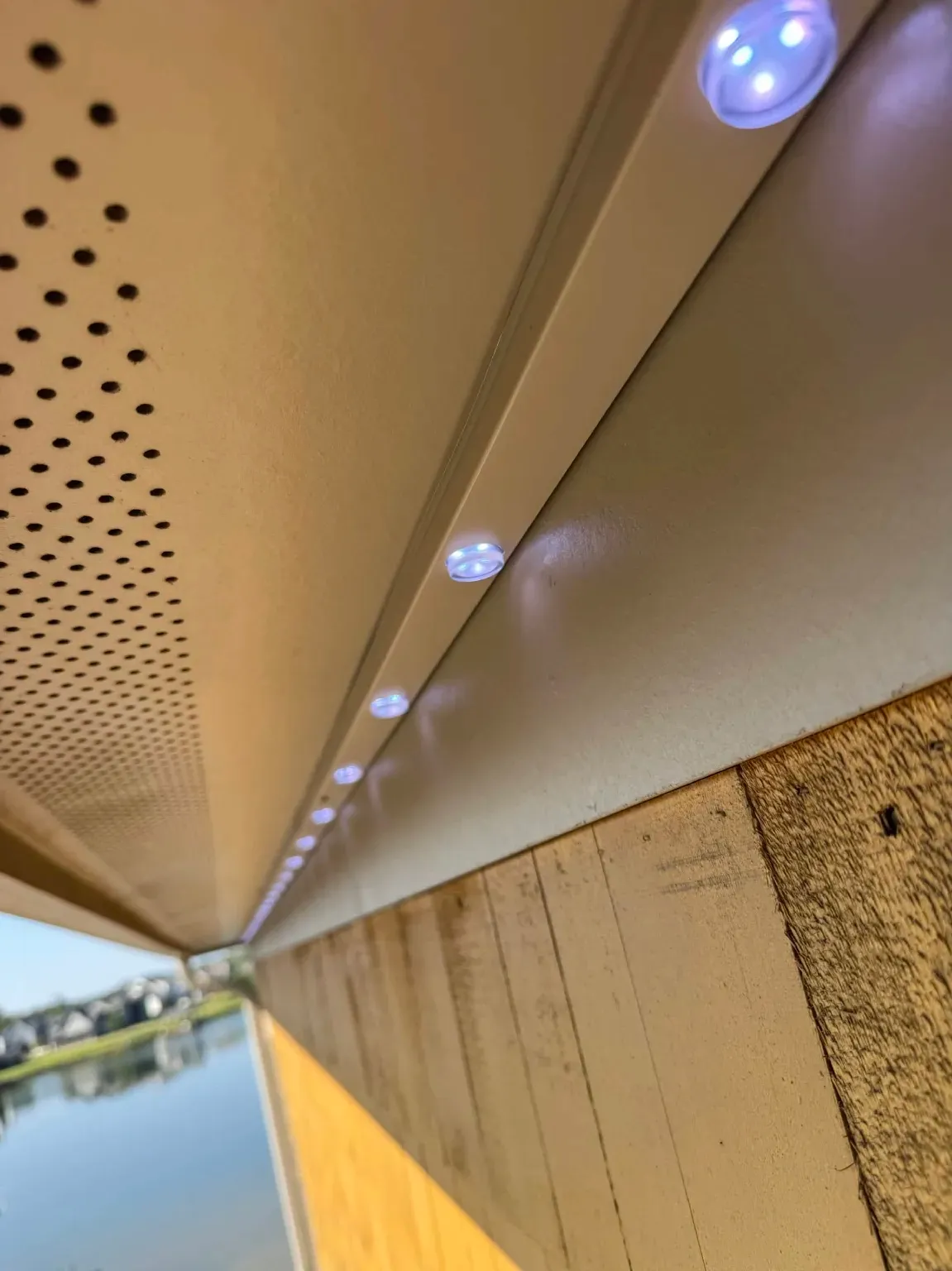
- Parts. Track, lights and mounting hardware, including whether the track is color-matched to your trim so it disappears in daylight.
- Controllers. How many, and whether they’re in the price. A JellyFish controller powers roughly 263 feet, so a larger house with a rear run can need a second. That belongs on the quote, not the invoice.
- Setup and testing. Installation, app setup, and a check of every zone before the crew leaves. Skipping that last step is one of the mistakes people make with permanent lighting.
- Warranty in writing. Parts and labor are often covered for different lengths of time, so look for both.
- Anything that changes the work. Gutter guards, for example, can cover the drip edge a clip would normally use, so the run moves to the fascia line. That’s easy if it’s planned and annoying if it turns up on install day.
Ask How the House Was Measured
A price given over the phone is an estimate, not a quote. The real number comes from someone standing at the house.
Vestavia Hills is a good example of why. On the older streets near the crest, the fascia is often shallow and broken up. In Liberty Park and the newer parts of Cahaba Heights, it tends to be long and straight. Where a lift can safely stand, what the gutters look like and whether guards are in the way all move the price, and none of that shows up on an aerial photo.
If two quotes list very different footage for the same house, ask each company what they counted. That’s usually where the gap is.
A Higher Honest Number Beats a Low Number That Creeps
It’s natural to lean toward the lowest quote. But the number that matters is the one on the final invoice.
A quote that starts low and picks up additions once the crew is on the roof isn’t cheaper. It moves the real cost to a point where it’s harder to say no. A fixed quote, even one that starts higher, lets you budget once and be done. If something about the house would change the price, you should hear it at the consult, not on the invoice.
How We Quote
Our design consult is free and happens at your house. We walk the property, measure every run you’re considering, check the fascia, drip edge and gutters, and work out where the controller can live. Then you get a fixed quote. The measurements are the measurements, and nothing is ordered until you approve it.
We bring both systems we install and tell you which one suits the house, including when that’s the cheaper one. On some of the older Vestavia Hills crest streets, a well-built seasonal display is the better answer, and we’ll say so. Our permanent vs seasonal comparison walks through when each one makes sense.
Get More Than One Bid
If you’re pricing permanent lighting in Vestavia Hills or Homewood, get a quote from us and get one from someone else. Match the scope, run the per-foot test on both, and read what’s included and what isn’t. If you’re still deciding who to trust with the house, our guide to choosing a permanent lighting company covers the bigger picture.
Get a bid from both. You’ll see the difference.
Request a free quote, call (205) 382-8991, or see what we plan around on Vestavia Hills homes.
Frequently Asked Questions
How do I compare two permanent lighting quotes?
Match the scope first. Check that both quotes cover the same sections of the house, then divide each total by its footage to get a per-foot number. Then compare controllers, setup, testing and warranty line by line. Price only means something once the scope is the same.
Why are two quotes for the same house so different?
Usually because they measured different things. One may include the rear run or the returns and the other may not. On sloped Vestavia Hills lots, the rear can be a story taller than the front, which changes the access and the price.
Should a permanent lighting quote include the controller?
It should at least say how many controllers the job needs and whether they’re in the total. Larger homes, especially with rear runs, can need more than one.
Can I get a permanent lighting quote over the phone?
Not a real one. The roofline decides the number, so we measure at the house before quoting, and the consult is free. For general ranges before then, start with our cost guide.