Permanent Lighting
Beyond Decoration: The Practical Side of Permanent Lighting
New Age Lights of Birmingham • October 2026 • Birmingham, AL • 7 min read
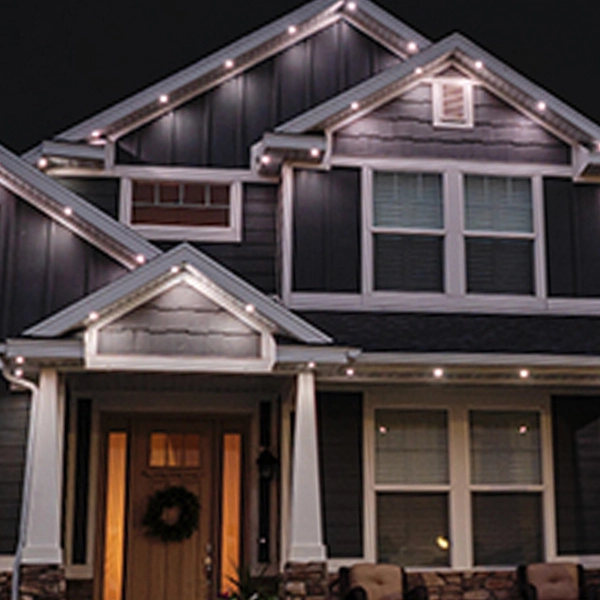
Short Answer: A permanently lit exterior does practical work that gets overlooked because the product is sold on holiday imagery. It makes a house findable from the street, gives footing and steps definition, makes a property read as occupied and attended to, and extends the usable feel of outdoor space into the dark half of the year. On security specifically, the honest position is that lighting is one modest factor among several rather than a deterrent on its own, and claims beyond that are overstated.
Permanent lighting gets marketed almost entirely on holidays and aesthetics, which undersells a category of everyday usefulness that has nothing to do with either.
Once a house is lit every night rather than six weeks a year, several practical things change. Here is what they actually are, along with an honest account of where the security claims in this industry go further than the evidence supports.
Being Findable
This is the most frequently mentioned benefit from people who have lived with a system, and it never appears in marketing.
House numbers are difficult to read at night. On a dark street, a delivery driver, a guest, a rideshare, or emergency services are all working from a mailbox number they cannot see and a row of dark facades that look identical.
A lit house is identifiable from a distance, and bringing the system up brighter when someone is on the way makes it unmistakable. Households use this constantly and it is entirely absent from the sales conversation.
It matters more on the winding and wooded streets common through the neighborhoods around Mountain Brook and the areas over the mountain, where sightlines are short and driveways are set back.
For anyone who has had an ambulance or a fire truck looking for their address, this stops being a convenience and becomes something else.
Footing and Orientation
Roofline lighting does not light a walkway, and it still changes how people move around a property after dark.
An illuminated building gives the eye a reference. Ambient light spilling down defines where the house is, where the entry is, and roughly where the ground is, which is meaningfully different from approaching a completely dark facade.
Where a roofline system genuinely does not substitute is for path lighting and step lighting. Steps in particular need light directed at them, and grade changes, retaining walls, and the sloped driveways common across this area all deserve dedicated fixtures.
The properties that work best at night generally combine the two. Roofline lighting defines the building and landscape lighting handles the ground plane, and they are designed together where possible.
If you are installing a roofline system and have never addressed landscape lighting, that is the natural moment to consider both.
The Security Question, Honestly
This gets oversold in this industry and it deserves a careful answer rather than a claim.
Lighting is generally considered one contributing factor in deterrence rather than a solution on its own. A lit property is more visible to neighbors and passersby, and visibility is the mechanism that matters. It is not a barrier and it does not replace locks, cameras, or an alarm system.
The research on lighting and crime is genuinely mixed and context dependent, and any company telling you a lighting system will prevent burglary is overstating what is known. We would rather say that than make a claim we cannot support.
What can be said more confidently is about appearance of occupancy. A house that is dark every night for a week reads differently than one that lights consistently at dusk. A system on an astronomic schedule lights whether or not anyone is home, which addresses the specific pattern of a house that is obviously unattended.
That is a modest benefit and a real one, and it is the honest version of the security argument.
Worth adding that lighting aimed outward creates glare that can actually reduce visibility for someone looking at the property. Fixtures recessed in channel and directed along the building rather than out at the street are better on this count as well as aesthetically.
The Dark Half of the Year
The practical benefit that shows up most in October and holds through winter is simply that the house exists visually.
Sunset moves quickly through October, and after the clock change on the first of November, most Birmingham households arrive home in the dark and leave in near dark. For roughly four months, the exterior of the house is not visible during the hours anyone is there to see it.
A warm everyday setting restores that. The landscaping, the brick, the architectural lines people paid for become visible again rather than disappearing at five thirty.
It changes the interior experience too. A lit exterior visible through windows makes a room feel less bounded by black glass, which sounds minor and is genuinely noticeable through the short days.
This is the use that carries the value proposition, and it is available every night at no recurring cost once the system exists.
Using the Outdoor Space
Alabama evenings are usable a large share of the year, and lighting extends that.
A patio or a porch with the house lit behind it feels like a place rather than an edge of darkness. Guests stay outside longer, and a gathering that would end at dusk continues.
This is not the same as task lighting for a grill or a dining table, which needs fixtures positioned for it. The roofline system provides the ambient layer that makes the space feel contained.
Where households have a pool, a deck, or an outdoor kitchen, the combination of roofline lighting for the building and dedicated fixtures for the space does considerably more than either alone. The building lighting provides the backdrop and the task fixtures make the area usable, and designing them together produces a better result than adding one to the other later.
What It Does Not Do
Being clear about the boundaries keeps the practical case credible.
It does not light a walkway, a set of steps, or a driveway. Those need fixtures aimed at the surface people are walking on, and on the sloped lots and long driveways common across this area that is a real gap if it goes unaddressed.
It does not illuminate a dark side yard or a rear corner of a property. A roofline system lights the building, and anything beyond the immediate spill is outside its reach.
It does not replace motion activated security fixtures, which do a different job. A steady architectural setting and a fixture that triggers on movement address different things, and a property concerned about the second should have the second.
Situational Use
A few uses recur enough to be worth naming, because they are the ones that turn a system into something operated rather than admired.
Bringing lights up when someone is arriving late. Running brighter during a gathering. Turning a section on when letting a dog out into a dark yard. Leaving a consistent schedule running while traveling.
All of these depend on the system being easy to operate, which comes back to presets and scheduling being configured at installation rather than left to the homeowner. A system that requires building a scene in an app to accomplish something simple gets used for holidays and nothing else, which forfeits most of what this article describes.
What to Do Next
Stand at the street in front of your house after dark and try to read your own house number. Most people cannot, and that single observation makes the findability point better than any argument.
Walk your approach and entry in the dark and note where the footing is genuinely hard to see. Those spots need landscape or step lighting rather than roofline lighting, and identifying them now means designing both together.
If security is part of your thinking, weight it appropriately. Lighting contributes to visibility and to a property reading as attended to. It is not a substitute for locks, cameras, or an alarm, and anyone selling it as one is overstating.
Plan on an astronomic schedule so the system runs consistently whether or not anyone is home, since consistency is where the occupancy benefit actually comes from.
To discuss a design that covers both the building and the ground plane, contact New Age Lights of Birmingham at 205-382-8991 or visit https://newagelights.com/new-age-lights-birmingham-al/. We serve Birmingham, Hoover, Vestavia Hills, Mountain Brook and the surrounding communities.