Christmas Lighting
DIY vs Professional Christmas Lights in Birmingham: Safety, Cost and What Usually Goes Wrong
New Age Lights • September 2026 • Birmingham, AL • 8 min read
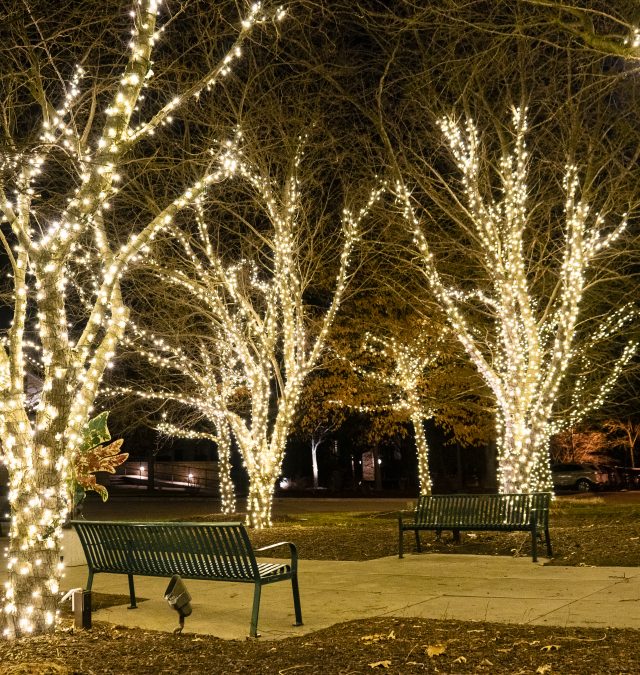
We install Christmas lights for a living, so you would expect this post to say hire a professional. It does not say that for every house. The decision should be made by looking at your actual roof, lot and December weather, and here is how those play out in Birmingham.
The ladder is the real problem
Every holiday season, ladder falls put thousands of people in emergency rooms across the country. Most are not dramatic: a foot slipping on a wet rung, a ladder base sliding on a slope, a reach too far toward a gable. They happen to people who have done the job a dozen times before. Birmingham housing makes it worse than average:
- Over the mountain. Mountain Brook, Homewood and Vestavia Hills were largely built between the 1920s and the 1950s. Steep pitches, slate and tile that cannot be walked on, deep decorative eaves and two-story fronts. The lots climb the slopes of Red and Shades Mountain, so the ground under the ladder is rarely level, and the hardwood canopy means the top of the ladder is often in branches.
- Hoover, Ross Bridge, Greystone, Chelsea. The fascia is straight and friendly, but the elevations are tall. A gable over the entry is usually beyond an extension ladder from the front, and the rear of a house on a sloping lot over a walkout basement can be three stories. Nobody should be up there on a ladder in December.
- The weather you would be doing it in. The wet arrives in November, shingles and rungs are damp, and the days are short after the time change.
Professional crews work at that height with the right access equipment as a matter of routine. A lift positioned at a spot settled on the site visit, not an extension ladder leaned against a gutter, is the core of what you pay for.
What a wet Alabama winter does to retail hardware
Central Alabama is wet more than it is cold. December averages a high near 55°F and a low near 36°F, and winter is the wettest part of the year. That combination is harder on Christmas lights than a properly cold winter would be. A display goes up damp, gets soaked by a front moving through, drops below freezing overnight, thaws by mid-morning, and repeats that cycle for weeks. Every few winters an ice event arrives on top of it.
What that does to retail hardware:
- Clips loosen. A generic plastic gutter clip expands and contracts with each cycle and slowly walks off the edge. By mid-January a run that was straight in November is sagging in scallops between the clips that held.
- Clips have nothing to grip. On the slate, tile and decorative eaves common in Crestline, Edgewood and the historic districts, a gutter clip was never going to work in the first place. The run has to go on fascia and drip edge with hardware chosen for that edge, which is not what is in the retail bin.
- Connections take on water. Retail plugs and sockets are not sealed for weeks of wet. Water gets in, a fuse blows or a section goes dark, and the fix is a climb in the rain.
- Strings do not fit. Retail strings come in fixed lengths, so on a real roofline they either fall short or bunch at the corners. Spacing drifts, and the display reads as effort rather than design.
A professional install uses commercial-grade C9 LED on runs cut to your house, clips matched to your edge, and sealed connections, with nothing through roofing material. That is why it still looks deliberate in late January.
What DIY actually costs
The box of lights is the visible cost. The full bill for a typical Birmingham roofline is longer, and it is worth writing out before deciding. For a modest two-story front with 150 to 200 feet of lit line, plan on buying:
| Item | What you need for 150 to 200 ft of roofline | Notes |
|---|---|---|
| Lights | Enough LED string or C9 run to cover every eave, gable and ridge you want lit, plus spare | Retail lengths rarely match a roofline; expect to have too much or too little at each corner |
| Clips | Several hundred, in the type your edge actually takes | Gutter clips do not work on slate, tile or decorative fascia |
| Power | Outdoor-rated extension cords, a timer, and enough circuits to avoid overloading one outlet | Cords across a lawn are a trip hazard and a mower casualty |
| Access | An extension ladder tall enough for your highest eave, and a level place to stand it | On a two-story front, a ladder that is tall enough is often unsafe to use alone |
| Replacements | Whatever fails in year two and three | Retail product in this climate rarely survives three winters intact |
| Time | A weekend to install, a climb each time a section dies, an afternoon to take down, and storage space | Untangling last year's lights and finding half the run dead is the part people remember |
Price the list at current retail and put it beside the typical professional range of $700 to $1,500 for a roofline, which includes product, install, in-season service, takedown and storage. The gap is usually smaller than the box price suggests, and it closes in year two when a lease renewal drops and retail strings start failing. The full breakdown is in how much Christmas light installation costs in Birmingham.
What usually goes wrong
These are what we see when called to fix a DIY display in December. None are the homeowner's fault; they are what happens when retail product meets Birmingham housing and weather.
- The run falls short or bunches at the corners because the string length was decided in a factory, not on your fascia.
- Gutter clips on a house with no usable gutter line, so half the run is taped, hooked over trim or, worst of all, stapled through shingles.
- Staples and nails through roofing material, which is a leak waiting for spring.
- One overloaded outlet feeding everything through daisy-chained cords, tripping a breaker every time the timer clicks on.
- The top of the gable left dark because the ladder ran out before the roofline did, so the outline stops in the middle of the elevation.
- A dead section after the first hard rain, and no one willing to climb up in the wet to find it.
- Lights still up in February because takedown needs the same ladder, the same weather and the same free weekend as install.
When DIY genuinely makes sense
There are Birmingham houses where hanging your own lights is a fine idea, and we would rather say so than talk you into a quote you do not need.
- Reachable single-story homes on level ground. A ranch in Bluff Park or on a flatter Homewood street, where every eave is within reach of a short, stable ladder, is a manageable job in dry weather with a second person holding the base.
- Ground-level and porch work on any house. Shrubs, porch railings, columns, windows, a wreath on the door and a lit tree in the yard need no ladder and look good against a plain roofline.
- Modest displays. One short run over the porch and nothing else is less than a professional program is built for.
- You enjoy it. For some families the Saturday on the ladder is the tradition. Just do it in the dry, in daylight, with someone at the bottom.
If you do go DIY: buy clips for your actual edge, use outdoor-rated cords and a timer, put nothing through the roofing, and stop at the height where the ladder stops feeling steady.
When to hire it out
Hand the job to a crew when the roofline is two stories or more, the pitch is steep, the roof is slate or tile, the lot slopes, the canopy is in the way, the house is in a historic district or an HOA with rules on how the display looks, or you do not have a free dry weekend in November. That describes most of Mountain Brook, much of Vestavia Hills and the taller half of Hoover. What a professional install includes is on our Christmas light installation page, and the questions to ask any installer are in hiring a Christmas light installer in Birmingham.
How do professionals install Christmas lights?
An estimator walks the property first, measures the roofline, looks at the edge, checks the power and settles where a lift can stand. You approve a design and a fixed quote. On install day, C9 LED runs are cut to fit each elevation, clips are chosen for the edge in front of the crew, tall elevations are reached from the lift, every section is tested and the schedule is set. If anything goes dark, you call and someone comes back. In January the display comes down and goes into offsite storage with your measurements on file.
A third option: no ladder, no annual install
If your objection to DIY is the ladder and your objection to a seasonal display is paying for it every year, price a permanent track. JellyFish Lighting and Bosso systems are fitted once under the roofline in a channel color-matched to the trim and run from an app: warm white on an ordinary evening, red and green in December, team colors on a fall Saturday. They suit the straight, continuous fascia of Hoover, Greystone, Liberty Park and the 280 corridor best. New Age Lights installs and services both. The five-year math is in permanent versus seasonal Christmas lights in Birmingham.
Frequently asked questions
Is it safe to put Christmas lights on my roof myself?
It depends on the roof. A single-story home with eaves you can reach from a stable ladder on level ground is a reasonable DIY job in dry weather. A two-story front, a steep pitch, a slate or tile roof, or a sloping lot where the ladder cannot sit level is not. Ladder falls send thousands of people to emergency rooms every holiday season, and Birmingham's over-the-mountain housing has all of those risk factors at once.
How do professionals install Christmas lights?
They measure the roofline first, then cut commercial-grade C9 LED runs to fit each elevation so the spacing holds and the line turns where the roof turns. Clips are chosen for the actual edge, shingle, gutter or fascia, and nothing is nailed or stapled through roofing. Tall elevations are reached from a lift placed at a spot settled on the site visit. Every section is tested, a timer or schedule is set, and the crew comes back if anything goes dark.
Why do my Christmas lights fall off the gutter every January?
Freeze-thaw. A central Alabama December averages a high near 55°F and a low near 36°F, and winter is the wettest season, so the display gets soaked, freezes overnight and thaws by mid-morning for weeks. That cycle works a hardware-store clip loose and finds any connection that was not sealed, and the ice event that turns up every few winters finishes the job. Clips sized to your edge and sealed commercial-grade connections are the fix.
How much does it really cost to do Christmas lights yourself?
More than the lights. For a typical roofline you are buying LED strings or C9 runs in the right length, a few hundred clips matched to your edge, outdoor-rated extension cords and a timer, plus replacements for whatever fails in year two. Then add your time: a full weekend for install on most two-story homes, a service climb whenever a section dies, and another afternoon for takedown. Compare that total against the $700 to $1,500 typical range for a professional roofline.
When does DIY make sense in Birmingham?
On a reachable single-story home with a simple roofline, on level ground, when you enjoy the job and the display is modest. Plenty of Bluff Park ranches and flatter Homewood streets fit that description. Shrubs, porch railings, windows and a wreath are DIY-friendly on any house. Once the work moves to a second story, a steep pitch, slate or tile, or a sloping wooded lot, hire it.
Is there a way to skip both the ladder and the annual install?
Yes. A permanent track from JellyFish Lighting or Bosso Smart Lighting is fitted once under the roofline and runs from an app, so there is no annual install, no takedown and no ladder. It suits straight, continuous fascia best, which describes most of Hoover, Greystone, Liberty Park and the 280 corridor. New Age Lights installs and services both and will tell you at the consult whether your roofline suits it.
Not sure which side of the line your house is on?
Book a free design consult. We will walk the property, tell you honestly whether a professional display is worth it for your roofline, and give you a fixed quote if it is. Nobody in your family goes up a ladder either way.
Get a free quote or call (205) 382-8991.