Permanent Lighting
Five Mistakes People Make With Permanent Lighting
New Age Lights of Birmingham • October 2026 • Birmingham, AL • 7 min read
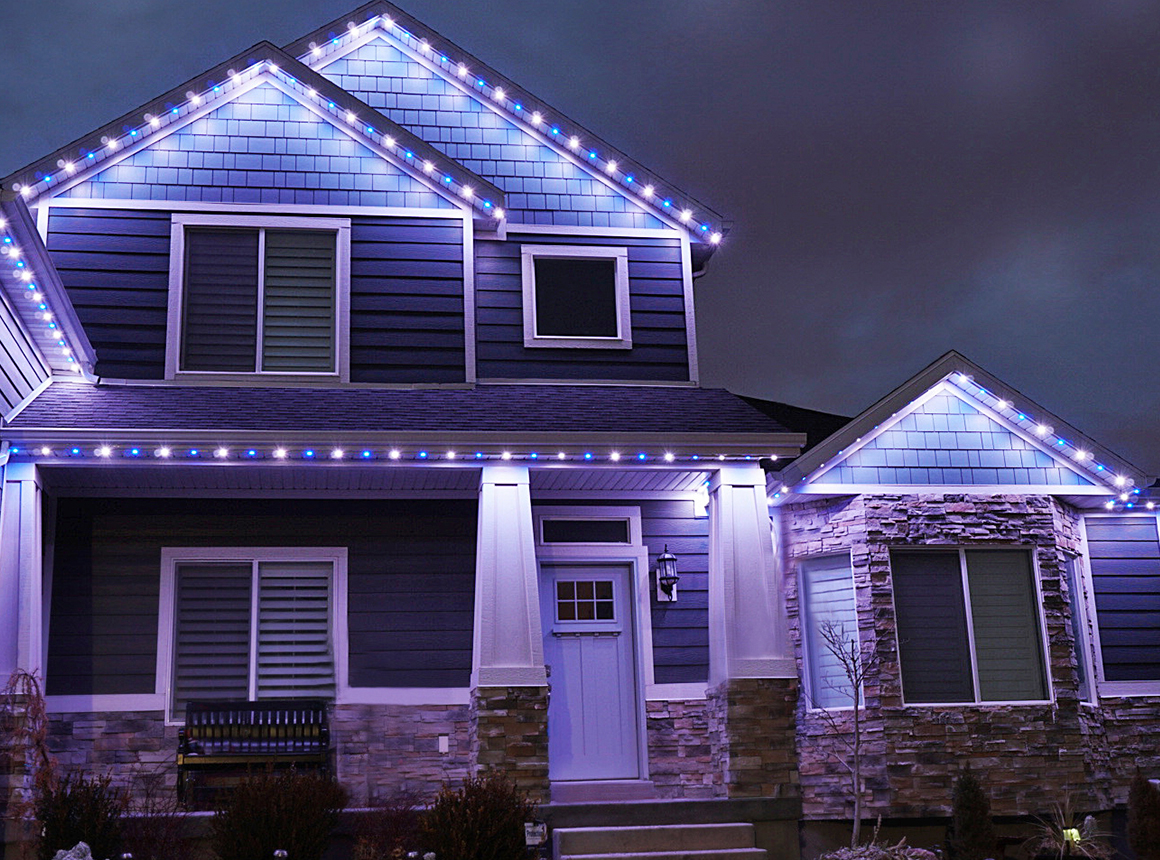
Short Answer: The regrets cluster into five, and four of them are decided before anyone climbs a ladder. Lighting every roofline instead of the lines that define the house, ending up with a cool white everyday setting on a brick home, accepting an installation that was never properly commissioned, buying on price from an installer using plastic channel and unsealed penetrations, and buying the system for December without planning to use it the rest of the year. All five are avoidable at the design stage.
Permanent lighting satisfaction is unusually bimodal. People either describe it as one of the better things they have done to the house, or they are quietly ambivalent about a system they rarely turn on.
The difference is almost never the product. It is a handful of decisions made before installation, and they are the same ones every time. Here they are.
One: Lighting Everything
The most common design mistake, and it is expensive in two directions at once.
The instinct is that more coverage is better, so every roofline gets track. What that produces is a shape traced in light rather than a lit building. The eye sees an outline, which reads closer to a cartoon than to architecture.
What works is following the lines that define the house. The primary roofline, the gables that give the elevation its character, a prominent peak or a covered entry. Emphasizing those creates hierarchy, and hierarchy is what makes an elevation read as designed.
Since linear footage drives price, restraint is also cheaper. Lighting the lines that matter costs less and looks better, which is an unusually convenient alignment.
The related version is lighting elevations nobody sees. A rear roofline facing woods contributes nothing visually and costs the same per foot as the front. Unless you look at it from inside or use the space behind the house at night, it is spend without return.
Two: The Wrong White
This is the single most common regret about an installed system, and it is entirely preventable.
The everyday setting is what the house looks like nearly every night, and on an RGB system that white is produced by mixing rather than by a dedicated warm diode. Left at a default, it frequently lands cool, reading blue or clinical.
On the brick and stone that dominate housing across Birmingham and over the mountain, cool white is actively unflattering. It makes warm masonry look grey and the house look institutional. Warm output, in the neighborhood of 2700K, flatters the same materials and reads as inviting.
The fix takes five minutes during commissioning and is nearly impossible to notice during a night time demonstration, where everything looks impressive. Specify warm on the everyday setting and look at it on your own house before the crew leaves.
Consistency with existing landscape lighting matters too. Two systems at different color temperatures on the same elevation read as mismatched even to people who cannot say why.
Three: Accepting an Uncommissioned System
Hardware installed is not the same as system finished, and this is where a lot of installations quietly end.
Commissioning means zones mapped, color temperature dialed, brightness set for nightly use rather than for a demo, presets built and named, and scheduling configured. A crew that mounts the track, confirms it powers on, and hands over an app has done maybe eighty percent of the job.
The consequence is predictable. A homeowner facing an app with no presets and a default configuration uses the system at Christmas and then rarely again, because every use requires building something.
Astronomic scheduling in particular determines whether a system runs itself. Set to track sunset by date, it handles the rapid shift through October and the clock change without anyone touching it. Left on a fixed timer, it drifts out of step and gets ignored.
Insist that presets exist before the crew leaves, and name them while someone is still on site. An everyday scene, a Christmas scene, a game day scene, and off covers nearly all real use.
Four: Buying on Price
This one does not show up for several years, which is exactly why it keeps happening.
Plastic channel is cheaper than extruded aluminum and becomes brittle and discolored under Alabama sun. Poorly sealed fixtures admit moisture in our humidity. Plated fasteners corrode and stain the fascia beneath them.
The most serious version is fascia penetrations that were not properly sealed. Those are holes through a surface whose job is keeping water out of the roof structure, and the consequence is not a dim section, it is water where it should not be.
None of that is visible at handover. All of it is visible around year five, at which point the cheaper installation has become the more expensive one and it is attached to your house.
The questions that prevent it take two minutes. Channel material, fixture ingress rating, fastener material, how penetrations are sealed, and whether the warranty covers labor or only parts.
Five: Buying It for December
The last one is a framing mistake and it determines the value of everything else.
A system purchased as Christmas lights that never come down gets used for about six weeks a year. The same hardware used as everyday exterior lighting works every night, which is a completely different return on the same money.
The households who are unambiguously happy with the purchase are running a warm architectural setting nightly. The ambivalent ones are the ones who think of it as holiday equipment sitting dormant most of the year.
This is worth settling before purchase rather than after, because it should change how the system is designed. A system intended for everyday use gets designed around restraint and the lines that matter. One intended for December gets designed around coverage.
Two Smaller Ones Worth Avoiding
Neither rises to the level of the five above and both come up often enough to mention.
Running brightness too high is the first. Nearly every system gets dialed down after the first week, and the ones that do not tend to be the ones the household grows tired of. Full output belongs in a holiday scene meant to read from a distance, not in an everyday setting viewed from across the street every night.
Sizing the controller with no headroom is the second. Most homeowners who start with a front elevation later want to extend to a side or a rear. A controller sized exactly to phase one turns phase two into an equipment purchase rather than an addition, and asking about capacity costs nothing at the outset.
Both are decided at installation and neither is obvious until months later, which is what they have in common with the larger five.
The Mistake That Is Not a Mistake
Worth saying, because people worry about it and it is the wrong thing to worry about.
Being visible during the day is not a failure. A well installed system reads as a narrow trim line following the roof edge, matched to the fascia color. If you look for it you will see it, and most people passing by do not register it at all.
The standard to hold an installer to is unobtrusive rather than invisible. Straight runs, mitered corners, capped terminations, matched color, concealed wire. Those produce a line that looks like part of the house.
Chasing literal invisibility leads people to reject a product that would serve them well, or to accept claims no installation can actually meet. The useful comparison is a gutter or a downspout. Both are visible, neither is something anyone notices, and that is the standard a well installed channel reaches.
What to Do Next
Before signing anything, walk your elevations at dusk and identify the three or four lines that actually define the house. That list is your design, and it will be shorter and cheaper than lighting everything.
Specify a warm everyday setting in writing and look at it on your own house before the crew leaves rather than judging from a demonstration video.
Ask what commissioning includes, and require presets and astronomic scheduling configured on site.
Ask the five hardware questions, and weight the answers more heavily than the price difference between two quotes.
To discuss a design built around the lines that matter on your home, contact New Age Lights of Birmingham at 205-382-8991 or visit newagelights.com. We serve Birmingham, Hoover, Vestavia Hills, Mountain Brook and the surrounding communities.